
By Dr. Robert Fortino, DO
At my weight loss centers in South Jersey and Philadelphia, patients often come in having already decided which one they want. They read about tirzepatide getting better numbers, or a friend did well on semaglutide, and they arrive with a preference.
I get it.
But the honest answer is that neither medication is better. One of them is better for you, and figuring out which takes a conversation about your gut, your body composition, and your metabolic history.
Here’s how I actually work through that decision.
What Both Medications Are Actually Doing
Both drugs work on hormones your body already makes. Understanding that changes how most patients feel about taking them.
Incretins, in Plain Terms
GLP-1 and GIP are incretin hormones. Special cells in your small intestine release them in response to food, and they signal your pancreas to secrete insulin. The name is a compression of “intestinal secretion of insulin.” These are peptide hormones, and they were discovered roughly 90 years ago. This is old biology, not new chemistry.
Where the Receptors Live
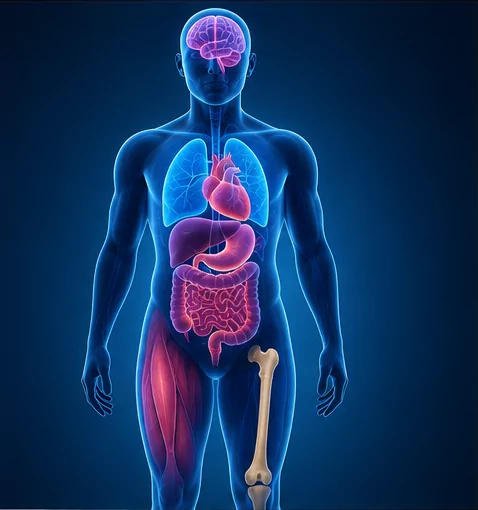
GLP-1 and GIP receptors aren’t confined to your gut. They sit throughout the body: in the brain, muscle, bone, fat tissue, heart, gastrointestinal tract, pancreas, and even the lungs. That distribution is why these medications do more than suppress appetite. They’re acting on a system that touches nearly everything.
The Shared Effect
Both semaglutide and tirzepatide stimulate these receptors and create an insulin sensitizing effect. That produces three things: reduced appetite in both the brain and the gut, reduction in visceral fat, and increased insulin sensitivity that eventually brings down post-meal glucose.
How Semaglutide Works on Its Own
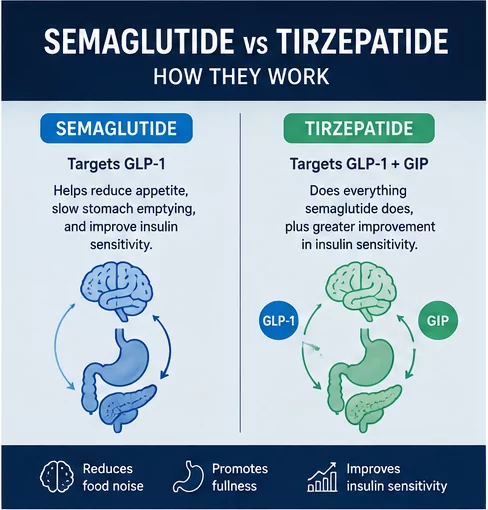
Semaglutide stimulates a single receptor, GLP-1, and that one pathway works on your brain and your gut at the same time. It makes you think about food less and feel full sooner.
In the brain, the effect is on how much space food occupies in your thinking. My patients describe this better than I can. The phrase I hear most often is that it reduces the food noise in their head.
In the stomach, intestines, and pancreas, those same receptors produce a feeling of fullness, slow how quickly your stomach empties, and slow intestinal transit time. You eat less, and you feel full while doing it.
Semaglutide also helps indirectly with fat metabolism, which creates a more insulin sensitive environment throughout the body. What you end up with is a real improvement in eating behavior, not simply a smaller appetite.
What Tirzepatide Adds That Semaglutide Does Not
Tirzepatide does everything semaglutide does, then stimulates a second receptor called GIP.
That extra pathway produces a greater improvement in insulin sensitivity, and it’s the entire difference between the two medications.
The GLP-1 half of tirzepatide behaves just like semaglutide. It quiets the food noise the same way and creates the same fullness in your gut. Anything you have read about semaglutide’s appetite effect applies here as well.
The GIP receptor is where they separate. Stimulating it may also improve your fat tissue’s ability to clear lipids. When adipose tissue clears lipids more efficiently, your muscle and liver absorb glucose better, which pushes insulin sensitivity further in the right direction.
That second pathway is the whole argument for tirzepatide. For the right patient, it matters. For others, it’s a difference that never shows up on the scale.
When I Start With Semaglutide
For all the attention tirzepatide’s second pathway gets, semaglutide is an excellent first treatment for any patient medically qualified to use this class of medication. It works, it works well, and for many people it’s all they need.
It’s also more affordable, and that matters more than prescribers like to admit. A patient on a stricter budget can start therapy with semaglutide and see real results without the higher cost. Starting treatment and staying on it beats holding out for a medication you can’t sustain. So while I move toward tirzepatide for specific reasons I’ll explain below, semaglutide is often where I begin.
Why Your Appetite Is Mostly a Psychological Problem
This is where I differ from a lot of prescribers, and it shapes how I use both drugs.
Appetite Is Something We Built
Hunger is physiological. We eat to survive. But appetite in a modern environment is largely psychological, and we created it ourselves through repetitive eating behavior. A smell triggers it. The sight of a particular food triggers it. None of that is your stomach reporting a deficit.
What Changed
Our ancestors didn’t eat three times a day or balance a plate. They hunted and gathered, kept their feet in the soil and their faces in the sun, slept when it got dark, and moved during daylight. No artificial light, no circadian disruption. We have dessert and snacks for one reason, which is that they’re there. That shift in how we eat and live is recent, and our biology hasn’t caught up.
The Addiction Pathway
Most of what is available now is processed and loaded with sugar and preservatives. That kind of food creates an addiction pathway that looks very much like what I’d see in a drug addict or a compulsive gambler. It runs on pleasure and the dopamine that follows. You’re not weak. You’re responding exactly the way the food was designed to make you respond.
Where the Medication Steps In
Semaglutide and tirzepatide stimulate GLP-1 and GIP receptors in the brain. The hypothalamus regulates appetite and satiety. The amygdala handles the emotional and reward side of eating. Acting on both is how these drugs help control the addiction reaction certain foods create, and how your brain regains the ability to turn off the food noise.
Why I Don’t Use BMI to Decide Anything
I want to be direct about this, because it separates my evaluation from most weight loss programs.
Where BMI Came From
BMI is Body Mass Index, the ratio of your weight to the square of your height. The formula dates to 1832 and a mathematician named Lambert Adolphe Jacques Quetelet. In the 1950s, insurance companies picked it up to calculate mortality risk in policyholders. It was never built as a clinical tool for the person in front of me.
The Problem With It
BMI can’t quantify how much body fat or muscle you carry. That’s a serious limitation, and it’s why I think the measurement should be abandoned rather than adjusted. A number that can’t distinguish fat from muscle can’t tell me anything useful about your metabolic health.
The Arnold Example
Arnold Schwarzenegger competed with a BMI somewhere between 30 and 32, depending on his weight that year. By that number he was obese. He was also carrying about 7% body fat at the time. Same number, completely different body. Run it the other way and a patient with a perfectly normal BMI of 24 can still carry high body fat.
What I Measure Instead
I measure body fat percentage directly, along with abdominal circumference. I use skinfold calipers to measure skinfold thickness, which translates into a body fat percentage. For the abdomen, I use a standard soft tape measure, in inches, around the biggest part of the belly, level with the ground. I take two measurements: one with you relaxed and not sucking in, and one with you sucking the belly in. That gives me a truer picture than a single number ever could.
For reference, a competitive bodybuilder generally sits around 7 to 9% body fat, men and women both, which is extremely hard to reach and harder to hold. A healthy range is roughly 15 to 24% for men and 22 to 28% for women.
Those ranges shift with the individual, their lifestyle, and their own preferences. They’re a starting point for a conversation, not a target I hand you.

How Your Type of Diabetes Changes My Decision
Diabetes isn’t one condition, and the distinction matters a great deal here. Broadly, it’s either insulin requiring or insulin resistant.
Type 1
Type 1 usually appears in childhood, which is why it’s called juvenile Type 1 diabetes. These patients need insulin to survive and are far more prone to diabetic ketoacidosis. Semaglutide and tirzepatide aren’t FDA approved for Type 1. Endocrinologists do use them, but that’s off-label use and it requires physician supervision.
LADA
In an adult who comes to require insulin, the condition is Latent Autoimmune Diabetes in Adults. LADA develops slowly and progressively, and insulin isn’t needed immediately. The risk of ketoacidosis is low but real. These patients can be prescribed either medication, with close monitoring throughout.
Type 2
Type 2 doesn’t require insulin therapy in most cases. Insulin resistance is fundamentally diet and lifestyle driven, and it responds to changes in environment, diet, and exercise. Both semaglutide and tirzepatide are FDA approved for this condition, and reversing insulin resistance is where these drugs do their best work.
How Side Effects Actually Decide It
Here’s the part that determines my recommendation more often than anything else.
Side Effects Are the Rate Limiting Factor
Every medication comes down to what you can tolerate. If a side effect doesn’t interfere with your daily life and you’re willing to continue, we continue with close supervision. If it produces genuinely untoward effects, stopping is the right answer. That principle governs both drugs equally.
The Gut Rule
The most common side effects from either medication are gastrointestinal: constipation, nausea, and gastric reflux. In my experience, tirzepatide produces fewer of these than semaglutide does. Semaglutide seems to generate more GERD symptoms and constipation at higher doses and with prolonged use.
So if a patient already has constipation or gastroesophageal reflux, I usually suggest starting with tirzepatide. This is my clinical observation across my own patients rather than a head-to-head trial finding, and I want to be clear about that distinction.
When I Keep You on the Drug
Both medications can produce these effects, so monitoring matters more than the initial choice. If a side effect is mild, self-limiting, and correctable with an over-the-counter product, we can continue regardless of which drug you’re on. Mild and passing isn’t a reason to abandon something that’s working.
When I Pull Back
If a side effect is interrupting your daily activities, I recommend holding the medication for at least one week, until you feel better. Then I like to see you face to face to evaluate what’s next: whether we resume the same medication at a lower dose, or switch you to the other drug. That decision only makes sense after we’ve seen how your body responded to coming off it.
When we do start a new medication, I brief you on the dose, the timing, and the side effects to watch for. Even though these two drugs act in similar ways, starting a new one calls for real informed consent, not an assumption that you already know what to expect. All of this is part of a broader philosophy about dosing that I cover in my full approach to GLP-1 treatment, where I explain why I aim for the lowest effective dose rather than the highest tolerated one.
What Cost and Insurance Really Look Like
My practice is fee for service. I’m not credentialed with any insurance or benefits program, and I’d rather tell you that plainly than have you find out later.
Many patients still receive reimbursement through their health plan. Insurance companies apply strict qualification guidelines, typically requiring a certain BMI and often additional comorbidities such as obstructive sleep apnea or an elevated HbA1c.
There’s an irony built into that system worth naming. If you start therapy and your BMI comes down, the insurer may stop reimbursing you for the medication that produced the result. And some plans that do cover it attach a co-pay high enough that coverage stops meaning much.
Coverage also depends on which form you’re taking. Insurers treat brand name Zepbound and compounded tirzepatide differently even though the active compound is identical, and that distinction catches a lot of patients off guard.
Which One Protects Your Muscle Better? Neither.
I get asked this constantly, and I think the question points in the wrong direction.
Why You Actually Lose Muscle
In a healthy person, muscle mass is lost for one reason: inactivity. There are pathologies that cause muscle loss, but those are a separate conversation and not what most patients are dealing with. Rapid weight loss of any kind will likely cost you some water, some fat, and some muscle. That’s a function of the rate, not the molecule.
Move However You Can
To preserve muscle density, I advocate for any type of exercise you’re willing and able to do. Building a bodybuilder’s physique isn’t a realistic goal for most patients, and it doesn’t need to be. Knowledge, time, and physical ability are all real constraints. Consistent strength work beats an ambitious plan you abandon in three weeks.
Protein and Fat Both Matter
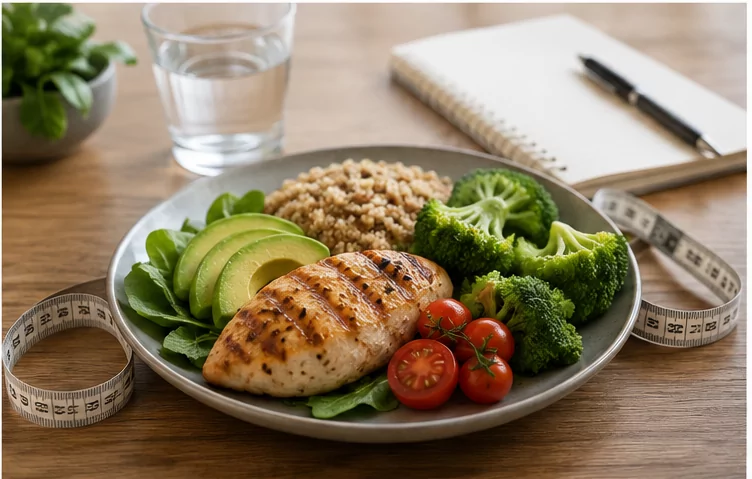
Protein and fat in your diet are essential for protecting muscle density. Protein supplies amino acids, the building blocks for growth. Fat is essential for protein absorption and helps signal hormones including testosterone and growth hormone. Cutting fat aggressively while trying to hold onto muscle works against you.
How We Decide Together
If you take one thing from this, let it be that the choice between these two medications isn’t a ranking. It’s a match.
Your gut history, your body composition, your type of diabetes if you have one, and what you can realistically tolerate all point toward one option or the other. That’s not something you can determine from an article or a friend’s experience, and it’s not something an online questionnaire can sort out either.
If you want to work through it properly, schedule a consultation and we’ll look at your history together and decide which one fits you.
FAQs About Choosing Between Semaglutide and Tirzepatide
Neither is better in general. Tirzepatide is a dual agonist working on GLP-1 and GIP receptors, which can produce greater insulin sensitivity improvements. Semaglutide works on GLP-1 alone. The right one depends on your medical history, your tolerance for gastrointestinal side effects, and your metabolic picture.
No. BMI can’t distinguish fat from muscle, which makes it misleading. Arnold Schwarzenegger competed at a BMI of 30 to 32 while carrying about 7% body fat. I measure body fat percentage directly along with abdominal circumference, because those numbers tell me what BMI can’t.
In my clinical experience, tirzepatide produces fewer gastrointestinal side effects than semaglutide. Semaglutide tends to generate more GERD symptoms and constipation at higher doses and with prolonged use. If a patient comes to me already dealing with reflux or constipation, I usually start them on tirzepatide.
That question misses the mechanism. In a healthy person, muscle is lost through inactivity, not through the medication. Rapid weight loss costs you water, fat, and some muscle regardless of which drug you use. Exercise you’ll actually do, plus adequate protein and fat, is what protects muscle.
Neither medication is FDA approved for Type 1 diabetes. Endocrinologists do prescribe them off-label, and that requires physician supervision because Type 1 patients face higher diabetic ketoacidosis risk. Adults with LADA can be prescribed either medication with close monitoring, since their ketoacidosis risk is lower.
My practice is fee for service and I’m not credentialed with insurance plans, though many patients do get reimbursed. Insurers set strict criteria, usually a BMI threshold plus comorbidities like sleep apnea or elevated HbA1c. Note that reimbursement can stop once your BMI improves.